
CORRIDOR 6: SERVICE CORRIDOR - Health, Educating, Empowering
This is the human development layer. It ensures every African has access to quality healthcare, education, and economic opportunity.
The Service Corridor includes:
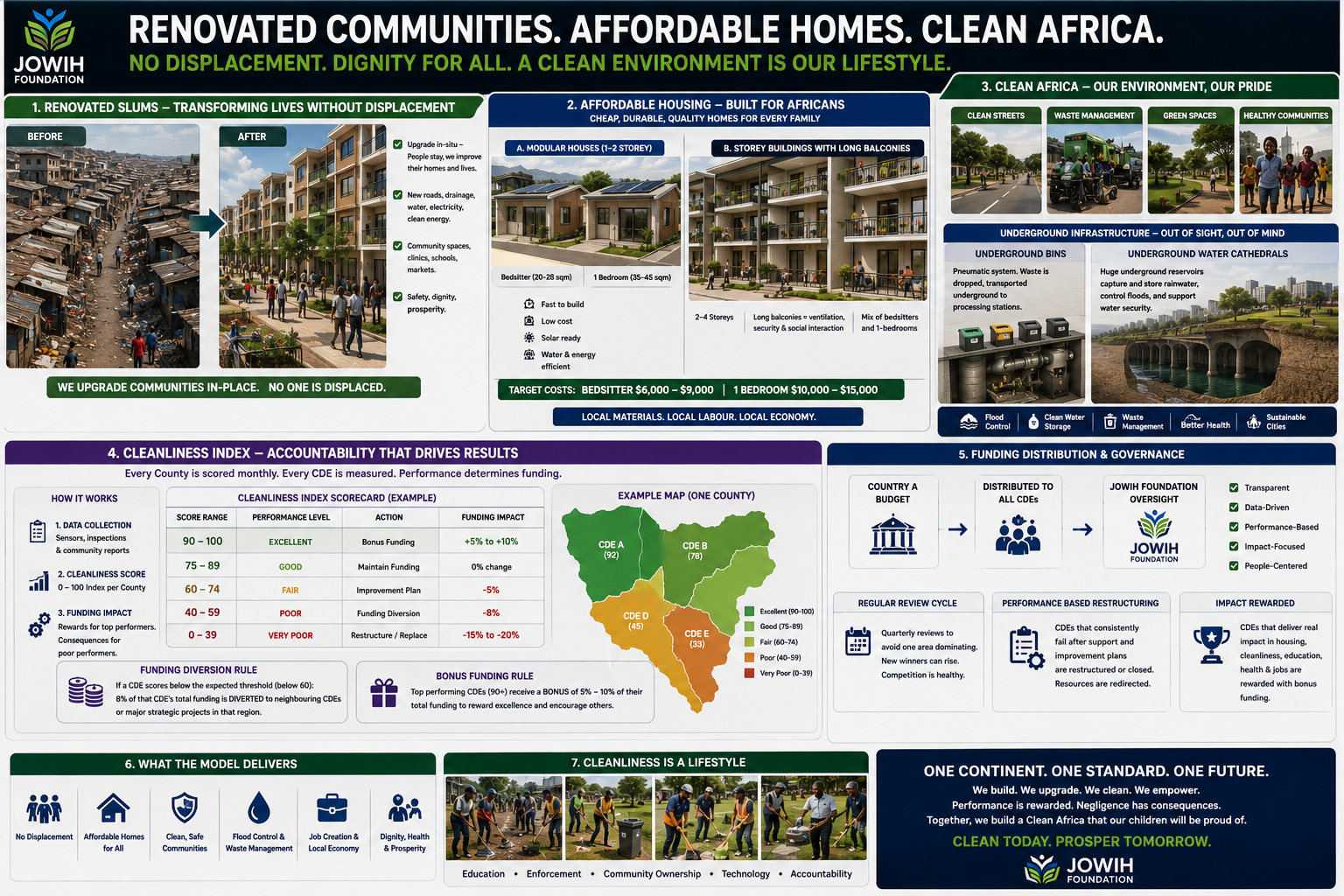
Afforable Housing: This plans to improve living standards and homelessness by building modular houses and do away with slums across Africa. Majorly bedsitters and single bedrooms. Totally affordable and maintains the zero displacement rule.
- Mobile Health Platoons — Tier 1-3 mobile clinics for villages (routine care, vaccinations, maternal health). Tier 4 Level 5/6 surgical platoons rotating between counties (major surgery, ICU, CT scan, blood bank).
Level 3 Hospitals & level 5/6 platoon- every county has a functioning level 3 hospital. Always open. Always staffed.Upgraded to level 5/6 on arrival of the tier 4 mobile Health platoon
- 3 Continental World-Class Hospitals — - Hospital 1 (North or West Africa): Cardiology, Oncology, General Surgery
- Hospital 2 (East or Central Africa): Neurology, Neurosurgery, Infectious Diseases
- Hospital 3 (Southern Africa): Trauma, Emergency, Pediatrics, Maternal Health
- Country Health Pot — ring-fenced health budget for each country. Direct procurement of medicines from African manufacturers and global. Distributed through Foundation health infrastructure
- Pharmaceutical Manufacturing — building African capacity for APIs, formulations, vaccines. Foundation-owned. Asset-locked.
- Health R&D Center — drug discovery, vaccine development, diagnostics, medical devices. Spin-off pharmaceutical and medical device companies.
- Jowih Care Fund — 30% of CDE profits allocated to relief for vulnerable populations. Food assistance, medical care, shelter, emergency relief.
- Jowih International Schools — 20 primary + 4 high schools per country in marginalized areas. Boarding high schools. Buses from CRT company. National curriculum. STEM education inclusion.
- STEM Labs — built in every Junior Secondary school. Fully equipped. Continental timetable. Standardized across time zones.
- Standardized STEM Broadcast Teaching — one teacher per subject per time zone reaches millions. P@P screens. Tablets. AI-assisted Q&A. Local teachers remain primary instructors. Virtual is a tool, not the system.
- Continental Teaching Hub — studio in New Dawn City. National broadcast studios per country for few selected subjects in Jowih International High Schools. Time-zone aligned schedule. Teacher training. Laboratory demonstrations. Supplementary instruction.
- Jowih learning Tablets/Laptops — ruggedized tablets with detachable keyboards. Manufactured or white-labeled. Pre-loaded with learning apps.
- Community development Enterprises (CDEs) — Five specialized CDEs per county/region depending on the country’s sub-country: Education and Scholarship, Agriculture and Food Security, Health and Wellness, Infrastructure and Energy, Digital and Innovation. 70% for community development projects. 30% for community-owned businesses. 30% of net business profits to Jowih Care Fund.
- Freemium Internet Model — Tier 1: Always Free (Jowih Asta , government services, educational content, health information). Tier 2: Premium Paid (general internet, entertainment, business tools). 50% for network expansion, 20% for CDE operations, 20% for community projects, 10% reserve.
- Exchange Programs — 2,500 trainees per year sent abroad for global expertise. Return as trainers, supervisors, and skilled workforce.
- Comrade Hub — workforce development pipeline. Local training. Online training. Exchange programs. Skills Registry. Placement in Track A (ADFA and flagships) or Track B (community-led projects in CDEs).
Country pot budgeting TO CDES --
Phase 1 (Years 1-5)
Country budget pots are established. Each signatory state receives annual allocations based on population needs, development indices, and impact potential. Funding is modest. Focus is on setting up CDEs, training local leaders, and piloting community projects. By the end of Year 5, CDEs are operational in thousands of communities.
Phase 2 (Years 5-10)
Country budget pots increase moderately. Funding remains annual. CDEs scale to tens of thousands of communities across all 54 countries. Rural development projects including schools, clinics, water systems, and environmental infrastructure accelerate. The Foundation prioritizes electricity investment and R&D Centers over heavy country budgeting during this phase.
Phase 3 (Years 10-20)
Country budget pots shift to quarterly disbursements. Funding is heavy. CDEs are fully mature. Rural communities have reliable electricity, internet, and infrastructure from Phase 2 investments. The Foundation now floods CDEs with capital to complete the transformation of every rural community. By the end of Year 20, every community has access to quality education, healthcare, clean water, electricity, internet, and economic opportunity while some completely transformed into urban centers/cities.
Regional Execution Hubs
Each hub is a center of excellence for its sector, executing projects across all 54 countries, not merely its region.
North Africa Operating Hub
- Sector focus: Energy, water, desalination, heavy transport
- Training focus: Solar technicians, water engineers, heavy equipment operators
- Exchange partnerships: China (hydropower), Germany (renewables)
West Africa Operating Hub
- Sector focus: Digital infrastructure, healthcare, education
- Training focus: Network engineers, health IT, digital literacy trainers
- Exchange partnerships: India (digital), China (telemedicine)
East Africa Operating Hub
- Sector focus: Transport (roads, rail, ports), agriculture tech
- Training focus: Civil engineers, equipment operators, agritech specialists
- Exchange partnerships: China (rail, ports), Netherlands (agritech)
Central Africa Operating Hub
- Sector focus: Forestry, mining infrastructure, water systems
- Training focus: Forestry managers, mining engineers, water system technicians
- Exchange partnerships: Brazil (forestry), Australia (mining)
Southern Africa Operating Hub
- Sector focus: Manufacturing, industrial infrastructure, renewable energy
- Training focus: Industrial engineers, manufacturing technicians, solar installers
- Exchange partnerships: Germany/China (manufacturing), China (industrial), South Korea (renewables)
- Mega STEM University — world-class institution in Africa focused on STEM education and research. Produces innovators and professionals for Africa.The MIT of Africa.
- Mega Orphanage — continental-scale flagship facility integrating comprehensive education and holistic care for bright orphaned children. Relevant franchises across africa too